Additive manufacturing for power plants
Nothing is more crucial to your success than sustainable and durable solutions. OSCAR-PLT’s wire and powder LMD technology offers you customised laser welding systems for additive manufacturing and repair that enable you and your personnel to significantly increase the longevity of your systems. Our innovative solutions help you to reduce maintenance costs and increase the efficiency of your hydropower plants. Our aim is to improve the profitability of your hydropower projects and make a joint contribution to sustainability.


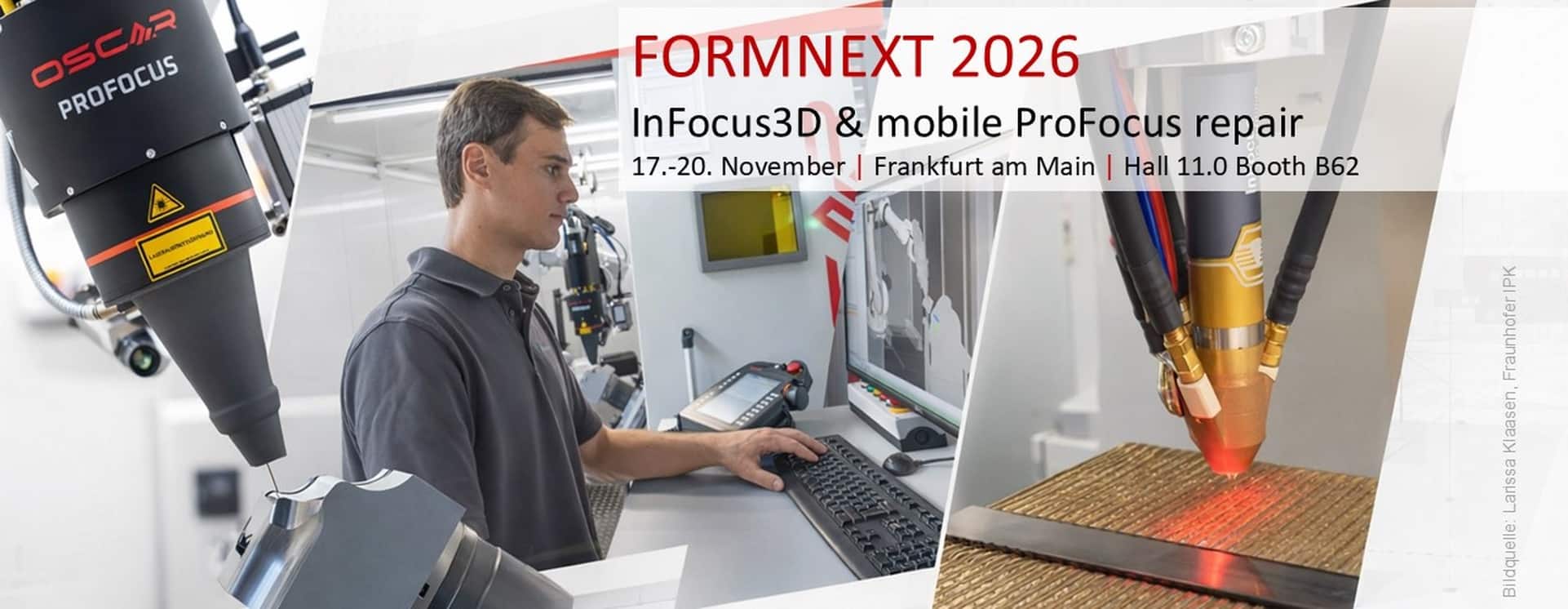
ProFocus is an intuitive, modular laser welding system that brings modern laser cladding into everyday production—enabling automated repair, coating and additive build-up of metal components with reduced material use, minimal rework, and stable, reproducible quality.

The compact version combines all the benefits of ProFocus technology in an innovative laser head whose efficient design enables completely new applications and geometries.

Turnkey laser cell for laser cladding, metal 3D printing, repair and coating of small to medium-sized components – compact, flexible and easy to use.
You are currently viewing a placeholder content from Brevo. To access the actual content, click the button below. Please note that doing so will share data with third-party providers.
More InformationYou need to load content from reCAPTCHA to submit the form. Please note that doing so will share data with third-party providers.
More InformationYou need to load content from Turnstile to submit the form. Please note that doing so will share data with third-party providers.
More InformationYou are currently viewing a placeholder content from hCaptcha. To access the actual content, click the button below. Please note that doing so will share data with third-party providers.
More InformationYou need to load content from reCAPTCHA to submit the form. Please note that doing so will share data with third-party providers.
More InformationYou are currently viewing a placeholder content from Turnstile. To access the actual content, click the button below. Please note that doing so will share data with third-party providers.
More Information