


Automated additive manufacturing and repair solution
The ProFocus WeldingCell combines component scanning, digital toolpath planning and robotic laser metal deposition in a turnkey system. It enables targeted repair, functional coating and additive manufacturing of metal components – with reduced planning effort, controlled material deposition and reproducible results.
The robot, positioning equipment, scanner and ProFocus process control work together in a coordinated system. OSCAR PLT supports you from the assessment of your welding task through system configuration to productive operation.
Your benefits at a glance
| • | An integrated digital process chain from component scanning to welding |
| • | Less manual work for component scanning and toolpath planning |
| • | Flexible component processing using a robot and tilt-and-turn positioner |
| • | Near-net-shape material deposition with reduced post-processing requirements |
| • | Stable processes through integrated monitoring and control functions |
| • | A configurable system for different components and applications |
| • | Process data logging for documentation and traceability |
| • | Expert support from feasibility assessment to production |
Manufacturing challenges
In repair and coating applications, components often vary in geometry, wear condition and accessibility. Capturing the actual component contour and planning suitable deposition toolpaths can therefore require considerable time and experience.
Typical challenges include:
| • | Significant effort required to scan and prepare worn components |
| • | Manual programming of complex processing toolpaths |
| • | Inconsistent results due to changing process conditions |
| • | Limited accessibility and time-consuming component positioning |
| • | Extensive post-processing caused by unnecessary material deposition |
| • | Skilled personnel tied up in setup, monitoring and process corrections |
What is needed is a system that reliably connects digital planning with automated processing.
The solution: ProFocus WeldingCell
A coordinated process chain for repair, coating and additive manufacturing
The ProFocus WeldingCell brings the individual processing steps together in an integrated robotic cell. A laser scanner captures the existing component geometry. The resulting point clouds form the basis for subsequent CAD/CAM processing and deposition toolpath planning.
The robotic system then carries out the planned operation using the ProFocus process head. A tilt-and-turn positioner helps orient the component appropriately and improves access to the processing surfaces.
The digital process chain includes:
| • | Component scanning and capture of the existing geometry |
| • | Point cloud generation and digital data processing |
| • | CAD/CAM-based planning of the processing strategy |
| • | Robotic laser metal deposition |
| • | Process monitoring and documentation of relevant process data |
This allows recurring repair and coating tasks to be standardised and complex operations to be prepared systematically.
Technology & system configuration
Precise material deposition in a flexibly configurable robotic cell
The ProFocus WeldingCell combines ProFocus laser technology with coordinated motion, scanning and control equipment. The specific configuration depends on component geometry, material, accessibility and the required processing result.
Technological advantages
| • | Defined energy input through six individually controllable laser beams |
| • | Direction-independent material deposition through central wire feeding and a coaxial beam arrangement |
| • | Low penetration and low dilution for the targeted build-up of functional layers |
| • | Near-net-shape processing to reduce material consumption and post-processing |
| • | Wire and powder processing in appropriately equipped system configurations |
| • | Local shielding gas coverage through adaptable shielding gas caps |
| • | Scanner integration to capture the actual component geometry |
| • | Component temperature monitoring to assess and document thermal process conditions |
The individually controllable laser beams allow the energy distribution to be adapted to the processing task. Together with material feeding, motion control and process regulation, this supports controlled material deposition – even with challenging geometries and materials.
Modular system configuration
The WeldingCell is designed as a complete system tailored to customer requirements. Key components include:
| • | ProFocus laser system with process head and material feeding equipment |
| • | Industrial robot for spatial positioning and movement of the process head |
| • | Tilt-and-turn positioner for workpiece orientation |
| • | Laser line scanner that can be integrated at the process head |
| • | Self-supporting protective enclosure with coordinated safety equipment |
| • | Integrated operator station for process control and monitoring |
| • | Application-specific workholding fixtures and additional peripheral equipment |
One possible system configuration combines a 2 kW laser system with a KUKA KR 50, a KR C5-2 controller and a DKP 500 positioner. The overall dimensions of this configuration are approximately 4,000 × 2,500 × 2,500 mm (L × W × H).
Robotics, positioning equipment, cell dimensions and equipment are tailored to the application. Depending on the task, system concepts incorporating other OSCAR welding technologies are also possible.
Process expertise & control
A capable robotic cell requires a suitable processing strategy. The interaction between captured component geometry, base material, filler material, energy input and motion control is crucial.
OSCAR PLT works with you to establish the process foundation for your application and implement it in a coordinated system workflow.
Support from OSCAR PLT
| • | Feasibility assessment based on your components and processing objectives |
| • | Selection of suitable processes and filler materials |
| • | Development of repair, coating and additive build-up strategies |
| • | Definition of process parameters and processing toolpaths |
| • | Coordination of robot motion, component orientation and material deposition |
| • | Assessment of heat input, layer build-up and required machining allowance |
| • | Testing and optimisation of processing through application trials |
This ensures that the system is tailored to the specific manufacturing task – from an individual repair to a recurring processing operation.
Software & process control
ProFocus process control combines welding parameter settings with assistance functions and process monitoring. The user interface allows operators to set relevant parameters, observe process conditions and use the available control functions.
In wire-based laser metal deposition, energy input, wire feed and working distance must be coordinated. Deviations can cause droplet formation at the wire tip (“balling”), the wire pushing into the workpiece (“sticking”) or uneven layer build-up.
Functions for stable and reproducible processes
| • | StartControl: automatic start-point detection and coordinated start-stop sequences for recurring deposition toolpaths |
| • | WireWatcher: wire process monitoring to help prevent uncontrolled wire break-offs |
| • | HeightControl: automatic height control to maintain the working distance and support consistent layer build-up |
| • | Anti-balling and anti-sticking: assistance functions to help prevent typical disruptions in the laser-wire process |
| • | HDR process observation: camera-based imaging of the processing area for process assessment |
| • | Variable beam control: adjustment of the individual laser beams to suit the processing task |
| • | Temperature monitoring: measurement and recording of component temperature to assess thermal behaviour over time |
| • | Process data logging: documentation of relevant process parameters for quality assurance and traceability |
The specific range of functions is tailored to the system configuration and application. The combination of digital planning, a controlled deposition process and documented parameters supports a repeatable workflow with reduced operator intervention.
Learn more about the process, materials and applications in our guide to laser metal deposition with wire.
Applications
For automated repair, coating and additive manufacturing
The ProFocus WeldingCell is suitable for companies looking to automate the processing of metal components and digitally connect their process steps. Particularly for complex contours and recurring processing tasks, the combination of scanning, toolpath planning and robotics supports structured process preparation.
Typical applications
| • | Restoration of worn component areas based on the captured as-is geometry |
| • | Functional coating of surfaces exposed to demanding operating conditions |
| • | Additive build-up of metal structures on existing components |
| • | Manufacturing and reproduction of metal components |
| • | Processing of complex contours with changing deposition directions |
| • | Standardisation of recurring repair and coating tasks |
Suitability for a specific material and the achievable component properties are assessed for each application. This also includes challenging tasks involving cast materials, tool steels or titanium.
Service & integration
From the welding task to productive system operation
OSCAR PLT supports you from the initial component assessment to the use of the WeldingCell in your production environment. Welding technology, motion control, the digital process chain and system operation are coordinated to meet your requirements.
Services
| • | Analysis of your application and technical requirements |
| • | Feasibility studies and application trials |
| • | Customised system configuration and design |
| • | Integration of scanning, robotics and positioning equipment |
| • | Installation, commissioning and process adjustment |
| • | Training in welding technology, system operation and motion systems |
| • | Knowledge transfer and support during production ramp-up |
| • | Technical service, maintenance and remote support as agreed |
The result is a complete system that enables your repair, coating and manufacturing tasks to be carried out in a predictable and reproducible manner.


Component scanning, data processing, toolpath planning and welding work together seamlessly. This reduces manual data transfers and planning steps.
The robot and tilt-and-turn positioner enable processing tailored to component geometry and accessibility.
Individually controllable laser beams and integrated control functions support near-net-shape results with low penetration and reduced post-processing.
OSCAR PLT combines system engineering with process expertise – from feasibility assessment and commissioning to support during ongoing operation.


Do you have questions about our company, our products or our services? Then you've come to the right place.
The ProFocus WeldingCell is a turnkey, configurable robotic cell for laser metal deposition, repair, coating and additive manufacturing.
It combines the ProFocus laser system with an industrial robot, a tilt-and-turn positioner, a component scanner and digital toolpath planning in an integrated solution. While ProFocus provides the welding technology, the WeldingCell also includes the motion, scanning and cell equipment required for automated processing.
A laser scanner first captures the existing component geometry. The scan data is used to generate a point cloud, which forms the basis for CAD/CAM-based process planning. Suitable deposition toolpaths are then generated and executed by the robotic system using the ProFocus process head. The tilt-and-turn positioner helps orient the component for processing. Connecting these steps digitally reduces manual data transfers and makes recurring tasks easier to prepare. The level of automation is tailored to the application and cell configuration.
The ProFocus process control system uses coordinated assistance functions to manage the interaction between energy input, wire feed and working distance. StartControl enables automatic start-point detection and coordinated start-stop sequences. WireWatcher monitors the wire process to help prevent uncontrolled wire break-offs. HeightControl regulates the working distance and supports consistent layer build-up.
Additional functions include anti-balling and anti-sticking assistance, camera-based process observation, component temperature monitoring and process data logging. The specific range of functions is defined during system configuration.
Yes. The ProFocus WeldingCell is configured to suit the components and processing tasks involved.
Options include the robot, tilt-and-turn positioner, cell dimensions, workholding fixtures, scanner and process equipment. Material feeding, software functions and integration into existing production workflows are also tailored to the application.
OSCAR PLT supports component selection and develops a suitable process strategy for repair, coating or additive manufacturing.
The ProFocus WeldingCell reduces manual tasks through a digitally connected process chain covering component scanning, data processing, toolpath planning and automated laser metal deposition.
Targeted, near-net-shape material deposition can reduce filler material consumption and subsequent machining requirements. For high-value components, repairing worn areas also allows the existing part to remain in use. The achievable savings depend on the application, the previous manufacturing or repair method and equipment utilisation.
The ProFocus WeldingCell is suitable for restoring worn component areas, applying functional coatings and additively manufacturing metal structures and components.
The scanner, robot and positioner are particularly useful for processing complex contours and recurring tasks. The component dimensions, weights and geometries that can be accommodated depend on the specific cell configuration. The suitability of the base material, filler material and processing strategy is assessed for each application and can be evaluated through a feasibility study.

ProFocus is an intuitive, modular laser welding system that brings modern laser cladding into everyday production—enabling automated repair, coating and additive build-up of metal components with reduced material use, minimal rework, and stable, reproducible quality.

The compact version combines all the benefits of ProFocus technology in an innovative laser head whose efficient design enables completely new applications and geometries.
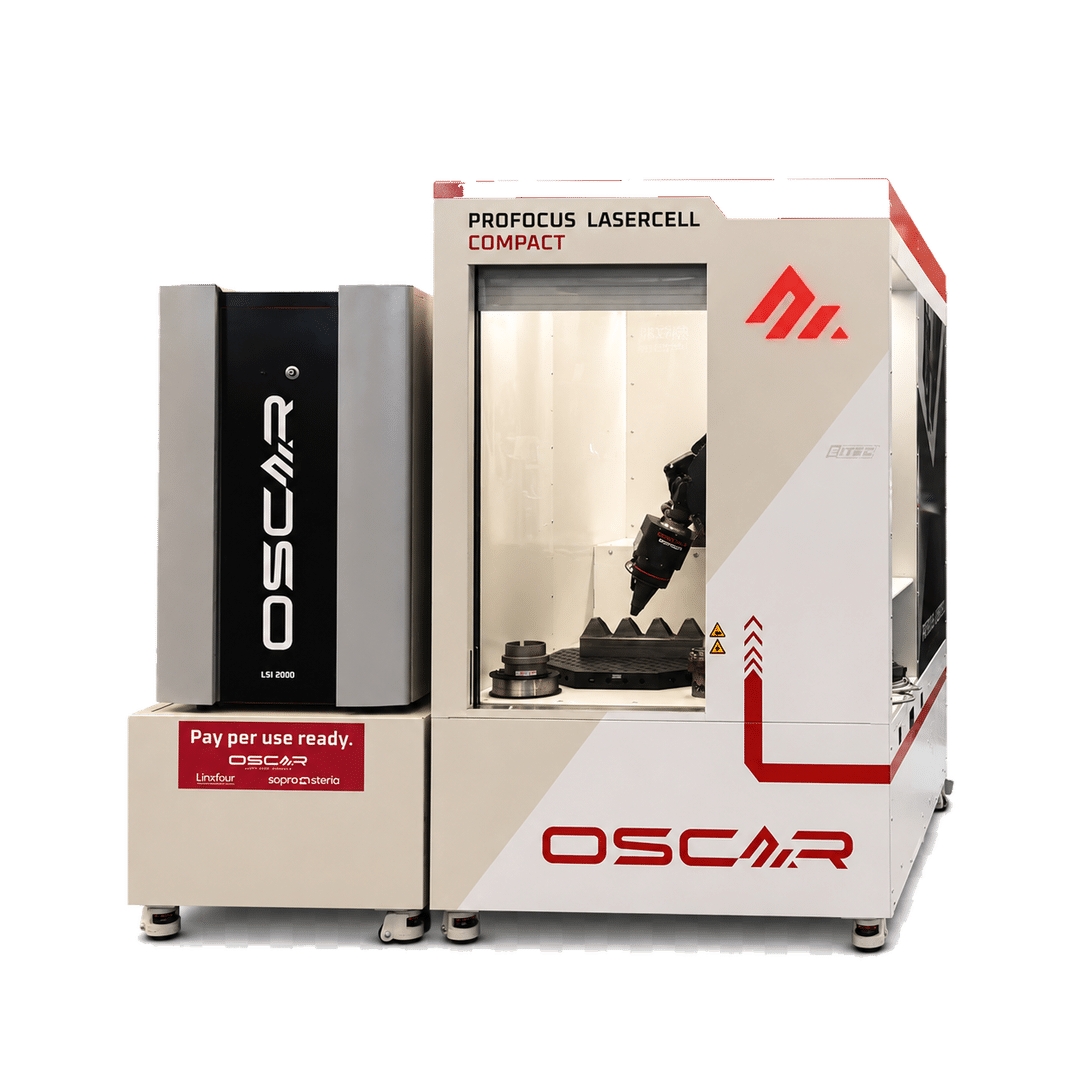
Turnkey laser cell for laser cladding, metal 3D printing, repair and coating of small to medium-sized components – compact, flexible and easy to use.
You are currently viewing a placeholder content from Brevo. To access the actual content, click the button below. Please note that doing so will share data with third-party providers.
More InformationYou need to load content from reCAPTCHA to submit the form. Please note that doing so will share data with third-party providers.
More InformationYou need to load content from Turnstile to submit the form. Please note that doing so will share data with third-party providers.
More InformationYou are currently viewing a placeholder content from hCaptcha. To access the actual content, click the button below. Please note that doing so will share data with third-party providers.
More InformationYou need to load content from reCAPTCHA to submit the form. Please note that doing so will share data with third-party providers.
More InformationYou are currently viewing a placeholder content from Turnstile. To access the actual content, click the button below. Please note that doing so will share data with third-party providers.
More Information