


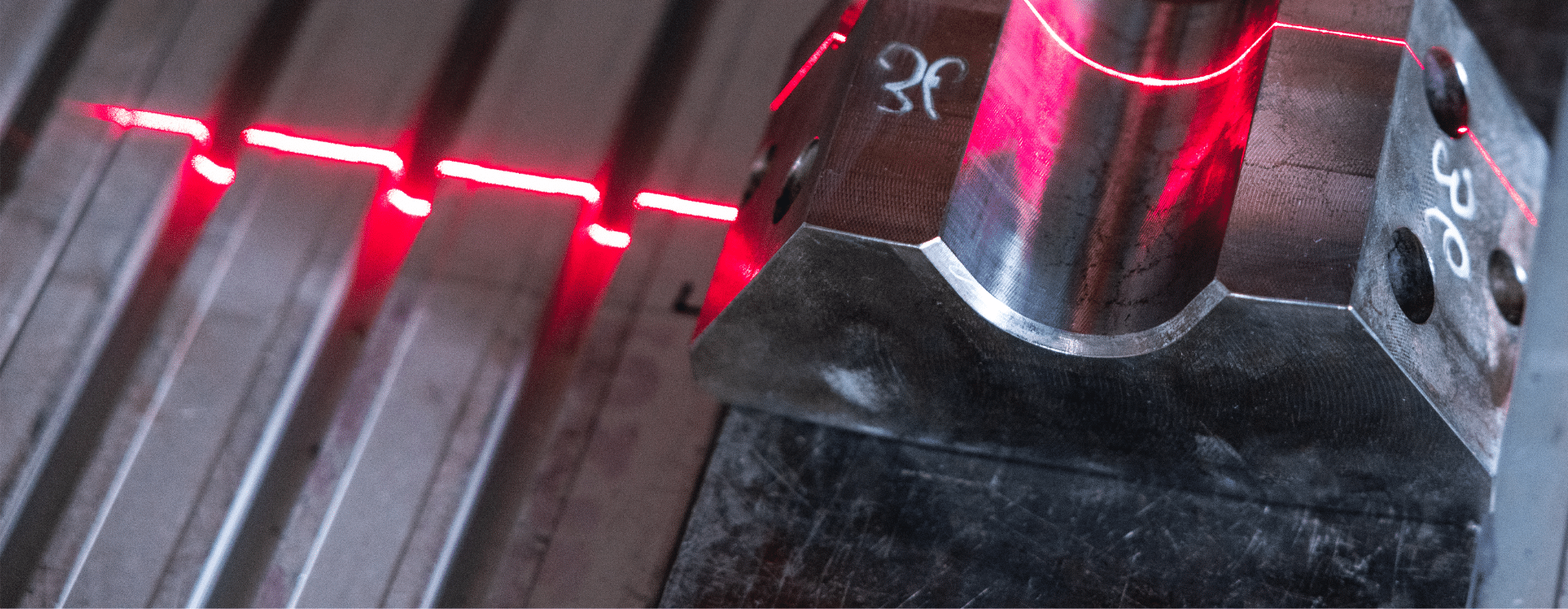
Laser Metal Deposition with Wire
Laser metal deposition with wire combines a precisely controllable laser process with the advantages of metallic welding wires. The process is suitable for the repair and refurbishment of metal components, functional coatings and the additive build-up of three-dimensional geometries.
At OSCAR PLT, we use laser metal deposition with wire particularly where material needs to be deposited selectively and reproducibly while controlled heat input, reduced rework and high material efficiency are important.
Unlike laser metal deposition with powder, the filler material is fed directly into the process zone as wire and is almost completely melted. This avoids powder losses caused by overspray or extraction. At the same time, the laser enables locally limited and precisely controllable energy input. This makes it possible to reconstruct damaged component areas, coat functional surfaces or build new geometries close to the final contour.
With our ProFocus technology, we combine the laser-wire process with process control, sensor technology and engineering expertise. OSCAR PLT supports you from the selection of suitable wire materials and feasibility studies through process development to the integration of laser metal deposition into existing CNC, robotic or manufacturing systems.
What is laser metal deposition with wire?
Laser metal deposition with wire, also referred to as wire-based laser metal deposition, wire LMD, LMD-w or laser wire cladding, uses a laser beam to melt metallic wire and deposit it selectively onto a component.
The process belongs to the group of Directed Energy Deposition (DED) technologies and is used for repair, coating and additive manufacturing.
The process can be simplified into four steps:
| • | The laser locally creates a defined molten pool on the surface of the base material. |
| • | A metallic filler material is continuously fed into the process zone in wire form. |
| • | Wire and base material are melted in a controlled manner and form a metallurgical bond. |
| • | Movement of the processing head and component creates individual weld beads, layers and ultimately three-dimensional structures. |
Compared with arc-based deposition processes, laser energy can be concentrated locally and controlled with high precision. Penetration, dilution and heat input can therefore be adapted to the specific component and material requirements.
What are the benefits of laser metal deposition with wire?
High material efficiency
In the wire-based process, the filler material is fed directly into the melt zone and is almost completely processed. There are no powder losses caused by overspray or extraction. Particularly when high-value or expensive filler materials are used, this can improve process economics.
Controlled heat input and reduced distortion
The locally limited laser energy input allows the heat-affected zone, penetration and dilution to be specifically influenced. This is particularly advantageous for repairs, thin-walled geometries or thermally sensitive components. A properly adjusted process can reduce distortion and the amount of subsequent machining required.
Simple material handling without metal powder
Welding wire is comparatively easy to store, transport and feed. At the same time, the typical requirements associated with powder handling and fine metal particles are avoided. Established welding wires and, depending on the application, flux-cored wires can also be used.
High level of automation and reproducibility
Laser power, wire feed rate, travel speed and other process parameters can be digitally controlled and synchronised. Laser metal deposition with wire is therefore suitable for automated robotic systems, CNC machines, compact laser cells and application-specific special-purpose systems.
Near-net-shape material deposition
By appropriately coordinating wire diameter, laser power, travel speed and process control, defined weld beads and near-net-shape structures can be produced. This reduces excess material and can minimise the effort required for milling, grinding or other downstream machining operations.
Repair instead of replacement
Laser metal deposition with wire is particularly attractive for high-value, large or difficult-to-source components. Worn areas can be rebuilt locally without replacing the entire component. This can make the technology economically attractive while also reducing material and resource consumption.
Wire, powder or arc – what are the differences?
Different processes are available for metallic material deposition. Whether wire, powder or an arc-based process is the best solution depends in particular on component geometry, material, required deposition rate, level of detail and economic requirements.
Laser metal deposition with wire is particularly suitable when:
| • | high material utilisation is important, |
| • | powder handling is to be avoided, |
| • | established welding wires or flux-cored wires are to be used, |
| • | repairs or three-dimensional build-ups are to be automated reproducibly, |
| • | controlled heat input is required, |
| • | material is to be deposited close to the final contour. |
Laser metal deposition with powder offers advantages when:
| • | very small or fine structures are required, |
| • | special material compositions are available only in powder form, |
| • | different powders need to be mixed selectively, |
| • | functional coatings using special alloys are the main focus. |
Arc-based deposition processes can be advantageous when:
| • | particularly high deposition rates are required, |
| • | larger weld beads and material volumes are needed, |
| • | higher heat input is acceptable for the component, |
| • | subsequent mechanical machining is planned anyway. |
There is no universally best technology. The decisive factor is which process provides the best technical and economic compromise for the component, material, geometry and production volume.
With ProFocus, both wire and powder materials can be processed. This allows the process strategy to be adapted to the respective application.
Typical applications for laser metal deposition with wire
Laser metal deposition with wire is used whenever metallic material needs to be added locally, a worn geometry needs to be reconstructed or a new structure needs to be built up.
Repair and refurbishment of worn components
Worn areas on shafts, bearing and fitting seats, sealing surfaces, gear teeth or other functional surfaces can be rebuilt locally. The existing component is largely retained, which can make the process an economical alternative to replacement, particularly for high-value components.
Functional coatings and local reinforcement
Specific component areas can be selectively provided with additional or functionally adapted materials. Highly stressed zones can therefore be locally reinforced without manufacturing the entire component from a correspondingly highly alloyed material.
Additive manufacturing with wire
Layer-by-layer deposition enables three-dimensional metal structures to be produced directly on existing components or on a substrate. Laser metal deposition with wire is therefore also suitable for additive manufacturing, hybrid manufacturing processes and the extension of existing component geometries.
Repair of demanding materials
The ability to precisely control energy input also makes the laser-wire process attractive for materials where heat input needs to be carefully controlled. Depending on the application, these may include cast materials, tool steels, high-strength steels or titanium alloys.
Suitable process parameters must always be determined specifically for the material and component.
Mobile repair of large components
Laser metal deposition with wire can also be integrated into mobile or flexible processing systems. Under suitable conditions, this allows large or difficult-to-transport components to be processed directly at their location instead of being completely dismantled and transported to an external repair facility.
Which wire materials can be used for laser metal deposition?
A major advantage of wire-based processing is the wide range of established metallic welding consumables available.
Depending on the base material, required function and process requirements, suitable wires can be based on:
| • | steel and stainless steel, |
| • | tool steel, |
| • | nickel alloys, |
| • | titanium alloys |
| • | and other application-specific alloys. |
Flux-cored wires can also be of interest for certain applications.
Whether a particular combination of base material and filler material is technically suitable cannot be determined from the material designation alone. Important factors include weldability, thermal properties, dilution, required coating properties and the subsequent loading of the component. Material selection is therefore a key part of feasibility and process assessment.
Which process parameters influence laser metal deposition with wire?
A stable and reproducible laser-wire process results from the interaction of several process parameters.
Particularly relevant parameters include:
| • | laser power and energy distribution, |
| • | wire diameter and wire feed rate, |
| • | travel speed, |
| • | position of the wire in the molten pool, |
| • | track width and layer height, |
| • | shielding gas flow, |
| • | distance between the processing head and component, |
| • | material and initial geometry, |
| • | temperature development during multi-layer build-up. |
The individual parameters cannot be considered independently. If the wire feed rate is changed, for example, the energy input and travel speed may also need to be adjusted. Process control and reproducible path planning are therefore particularly important for complex geometries and multi-layer structures.
ProFocus for laser metal deposition with wire
With ProFocus, OSCAR PLT has developed a modular laser metal deposition system for wire and powder. Six individually controllable laser beams are arranged concentrically around the central filler material feed. The coaxial wire feed enables direction-independent processing and makes automated processes and complex tool paths easier to implement.
For wire-based processing, ProFocus offers:
| • | coaxial wire feeding for direction-independent processing, |
| • | processing of different wire materials, |
| • | use of suitable flux-cored wires, |
| • | defined control of energy input using six laser beams, |
| • | controlled penetration and low dilution, |
| • | integration into CNC systems, robots or mobile systems, |
| • | combination of wire and powder processes within one system platform. |
ProFocus can therefore be used for repair and coating as well as for the additive build-up of metallic structures.
Who benefits from laser metal deposition with wire?
The process is particularly relevant for companies that manufacture, repair or protect high-value metal components against wear.
Typical situations include:
| • | replacement of a component is expensive or associated with long lead times, |
| • | only individual areas of a component are worn, |
| • | high-value base components are to be reused, |
| • | material should only be applied where it is actually required, |
| • | repair or build-up processes need to be automated and reproducible, |
| • | conventional welding processes cause too much heat input or rework. |
Applications can be found in areas including:
| • | mechanical and plant engineering, |
| • | toolmaking, |
| • | mining and raw materials, |
| • | steel production and rolling mills, |
| • | energy and power generation, |
| • | foundries, |
| • | repair and maintenance services. |
The decisive factor is often not the industry itself but the specific component challenge: where metallic material needs to be added locally, laser metal deposition with wire can offer a technically and economically attractive solution.
How economical is laser metal deposition with wire?
Economic viability cannot be assessed solely on the basis of the welding process costs.
Relevant factors include:
| • | value and replacement lead time of the existing component, |
| • | extent of the damaged or worn area, |
| • | material costs, |
| • | processing and machining time, |
| • | required pre- and post-processing, |
| • | downtime costs, |
| • | degree of automation, |
| • | production volume and frequency of repeated applications. |
The process can be particularly attractive when a high-value component is only locally worn and can be reused by selectively rebuilding material. Rather than comparing only the direct costs of a new component and a repair, the entire process should therefore be considered – including delivery time, machine downtime, material consumption and post-processing.
How OSCAR PLT supports laser metal deposition with wire
OSCAR PLT considers not only the laser process itself but the complete application – from the component challenge to the finished process solution.
1. Analyse the component and application
We first assess geometry, base material, damage pattern or required build-up geometry, loading conditions and economic requirements.
2. Select the process and filler material
Based on these requirements, we evaluate whether wire, powder or a combination of both processes is suitable and which filler materials can be used.
3. Evaluate feasibility and develop the process
Suitable process parameters are developed using trials and sample components, and the achievable results are evaluated. Depending on the application, this may include geometry, material deposition, surface quality, microstructure or required post-processing.
4. Automate and integrate the process
Once the process has been validated, it can be transferred to a suitable production system. Depending on the application, this can range from an individual ProFocus processing head and integration into existing CNC or robotic systems through to a turnkey laser cell.
5. Transfer process expertise
Through training, process support and equipment service, we help customers use laser metal deposition with wire reproducibly in ongoing production.
Is laser metal deposition with wire suitable for your component?
Whether the laser-wire process is technically and economically suitable depends on the component, material, geometry, damage pattern and required result.
OSCAR PLT helps you answer this question based on your specific application rather than theory alone. From the initial feasibility assessment through process trials and sample components to integration into production, we develop a suitable solution for repair, coating or additive manufacturing with wire.